 Strangelight Audio
2.3. Cables and signals
A cable carries a signal between two sockets. Connections and sockets teaches the routing actions and explains refused or warned connections.
2.3.1. Cables
A cable is a route from an output socket to an input socket. It carries one signal kind, and its colour matches that kind. One output can feed more than one input, so the same source can reach an audio destination and an analyser without duplicating the source node. The picture shows the Filter output feeding Audio Output and Monitor together.
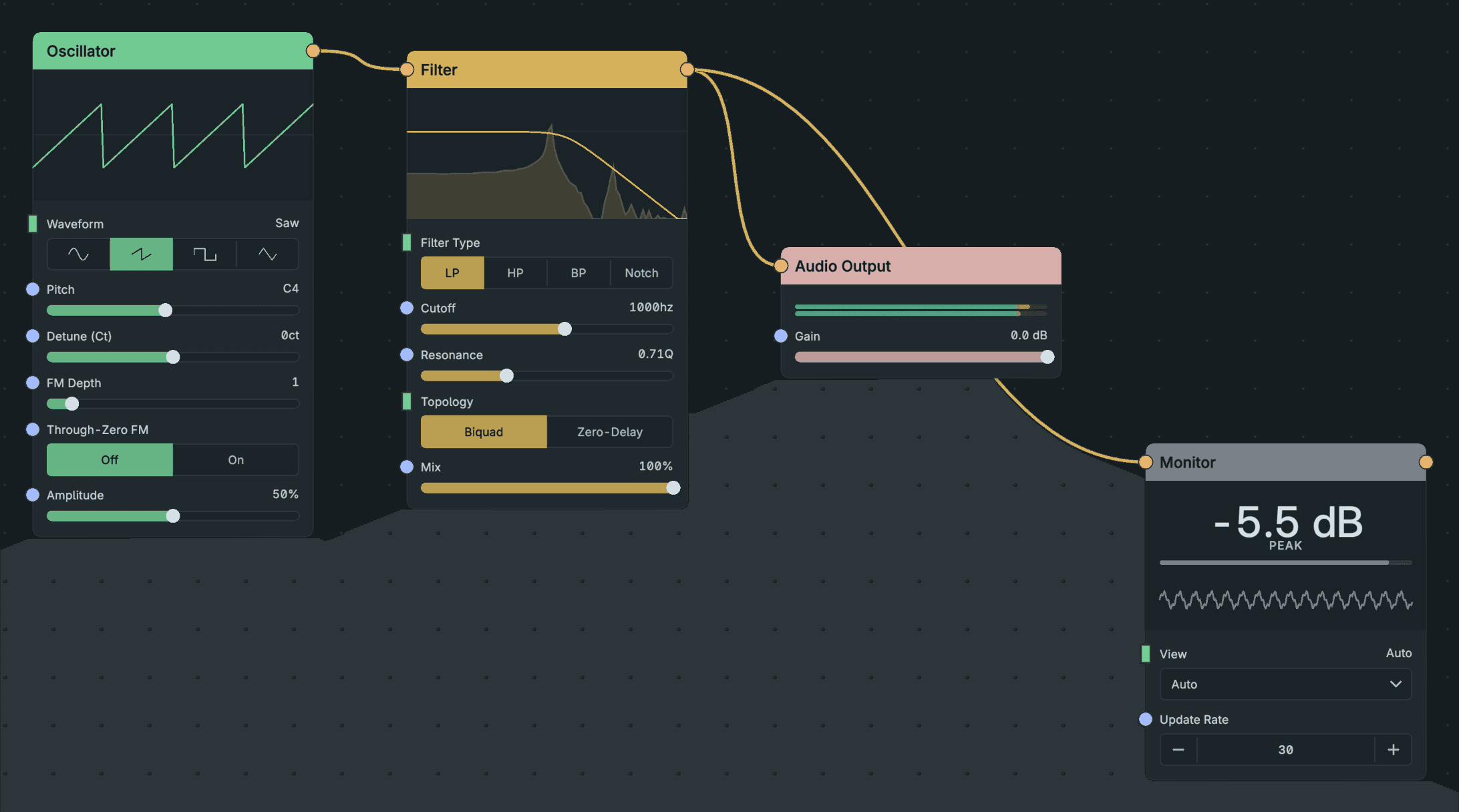
One Audio Source Feeding Two Destinations.
The direction of the cable matters: an output supplies a signal and an input receives it. A cable connected to a parameter input becomes that parameter’s driver. A cable connected across a Group boundary exposes or receives a signal on the Group node.
Pause the pointer on a cable and Help, a tooltip beside the pointer, names its two ends. Pause on a socket to read its signal. Throughline refuses routes that cannot work. Other routes stay valid but show a warning, because the numbers they carry can give an unexpected result.
2.3.2. Signal kinds, units and ranges
A signal kind describes what flows along a cable: audio, control, gate, trigger, MIDI or a structured signal such as Clock. A unit describes what a number means, and a range describes the values a socket expects. These are separate properties. In this picture, Map Range turns a controller’s 0–1 value into the Oscillator’s pitch range.
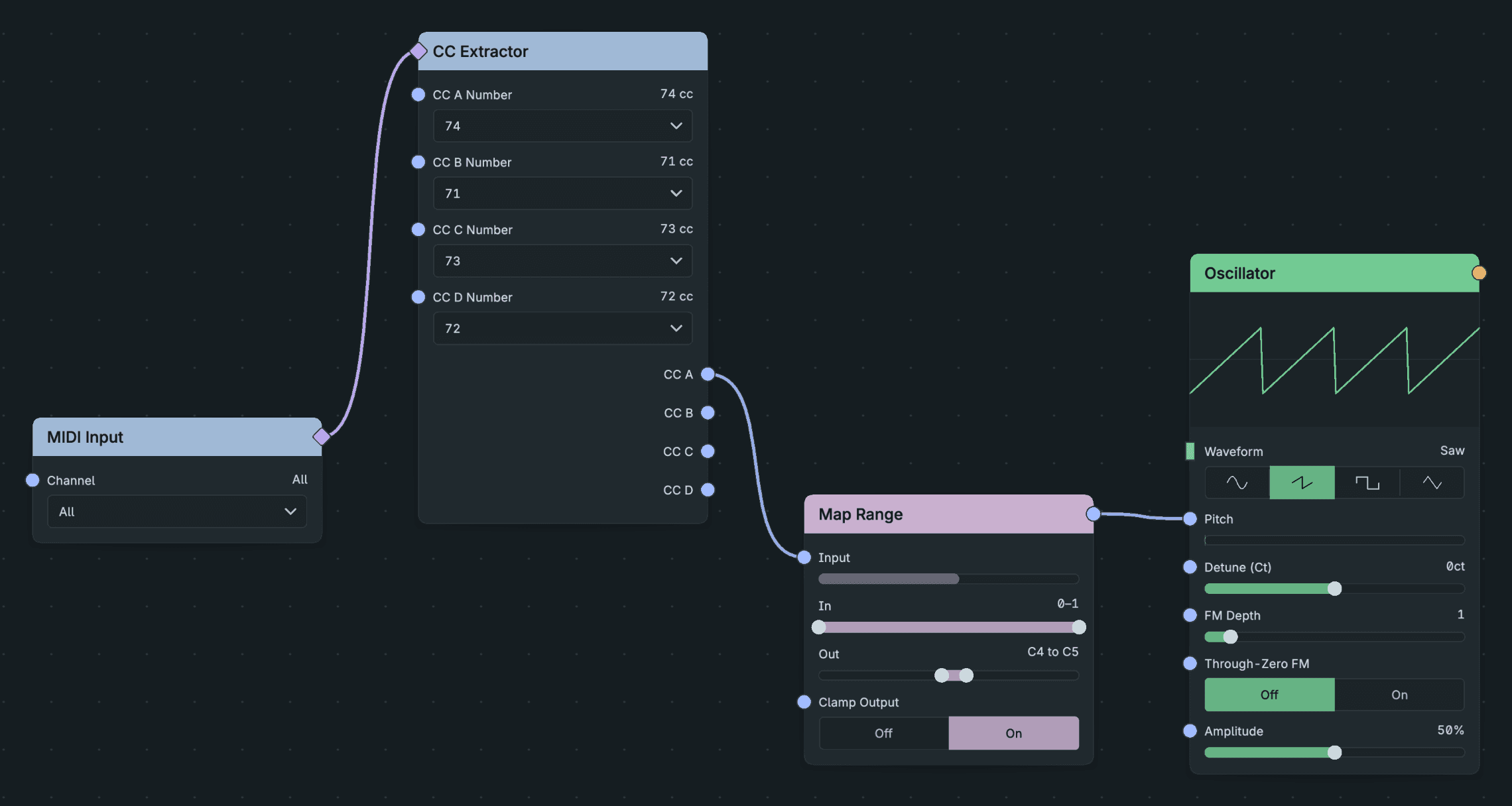
A Controller Value Mapped Into A Pitch Range.
Two control sockets can carry different units, such as hertz and milliseconds. A 0–1 envelope sent directly to a cutoff input does not describe the same frequency sweep as a mapped range.
A gate is a held on/off state. A trigger is a single event. MIDI carries messages such as note starts and releases. Clock carries musical timing. A normalised range describes an expected scale; it does not prevent clipping when signals are amplified or added.