v0.1Latest

Sound Sources

Every audio patch starts with something that generates a signal. Throughline ships four kinds of source, and they suit different jobs.

Oscillator

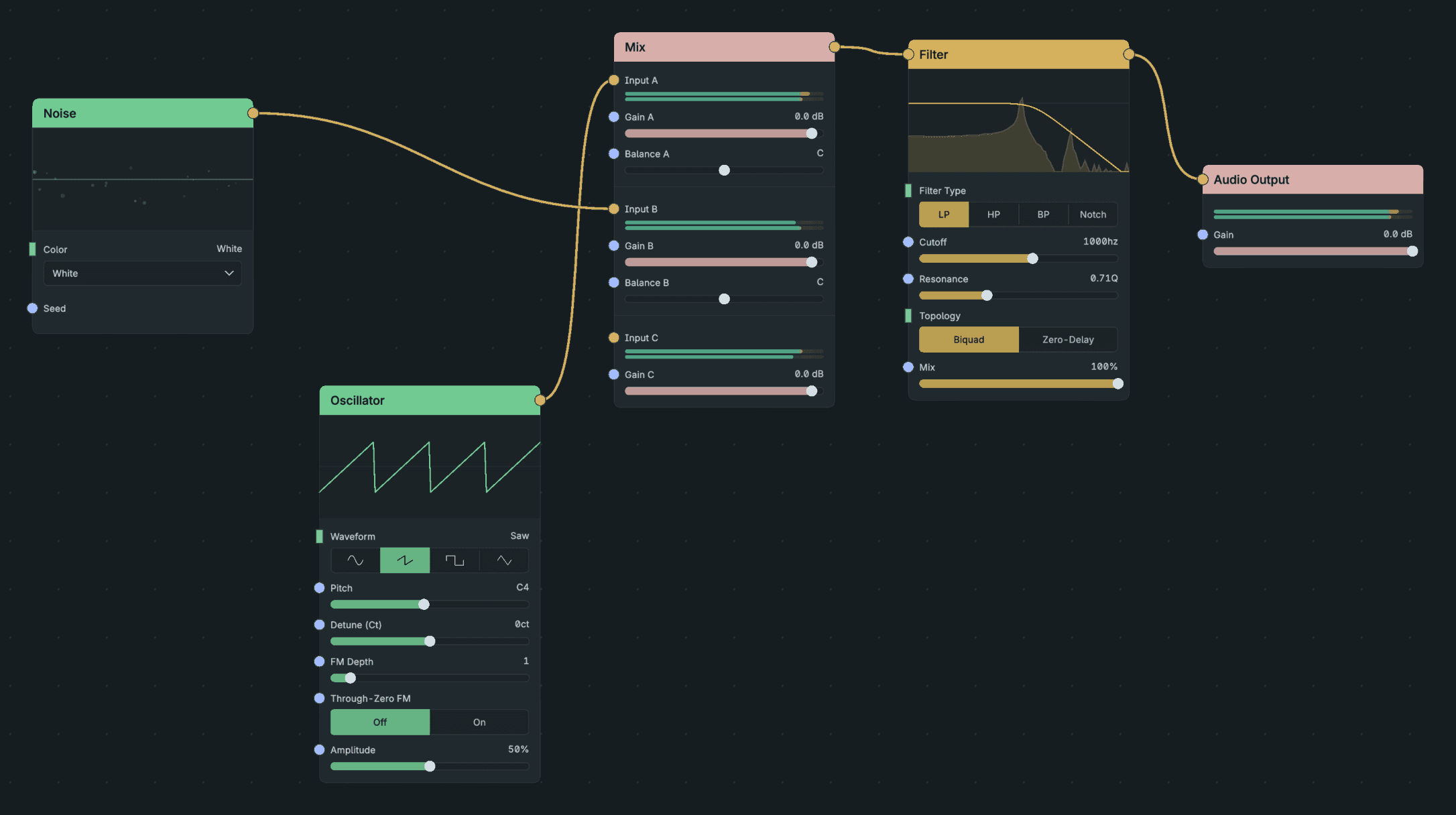
Oscillator is the default choice for pitched tones. Waveform selects Sine, Saw, Square, or Triangle, generated anti-aliased so high notes stay clean.

Beyond the basics it carries more than most patches use:

  • Pitch accepts a MIDI note, a control signal, or a plain number. The Pitch parameter sets a base note and is overridden whenever the input is connected.
  • Detune fine-tunes in cents, ±100, where 100 cents is a semitone.
  • Pulse Width sets the duty cycle of the square wave, and is an input as well as a parameter — modulating it gives classic PWM.
  • FM takes a linear FM input in Hz at audio rate, scaled by FM Depth. Patch another oscillator's output here for FM tones.
  • Sync resets the phase on a trigger, for hard-sync sounds.
  • Phase offsets the start of the cycle.
  • Unison Voices, Unison Detune, and Unison Spread stack detuned copies for width — see Polyphony and Voices.

Wavetable

Wavetable is the oscillator for tones that move. Instead of one fixed shape it reads through a bank of waveforms:

  • Table picks a curated source bank — digital, analog-style, formant, and complex spectra.
  • Position scans between the frames inside that bank, and is a control input, so an envelope or LFO can sweep the timbre the way it would sweep a filter.
  • Interpolation chooses none, linear, or Hermite for how smoothly frames are read.

Band-limited tables keep high notes from aliasing. Reach for Wavetable when the character of the sound should change over the note; reach for Oscillator when it should not.

Noise

Noise generates unpitched material. Color selects White, Pink, or Brown — progressively weighted toward lower frequencies.

Use it for percussion, breath and texture layers, wind and rain, and as a source for Sample & Hold when you want stepped random modulation. Filtered noise with a fast envelope is the basis of most synthesised drums.

Seed makes the output reproducible; leave it at 0 for a non-deterministic seed.

Modal Resonator is a physical-modelling body rather than a waveform generator. It has a bank of tuned modes that ring when excited, like a string, bar, plate, or tube.

It takes Audio In as the excitation, so it needs something to hit it — a noise burst, an impulse, or any audio signal. Pitch sets the fundamental, Decay sets how long it rings (0.05 to 12 seconds), and Damping shapes the character of that decay.

Signal flow diagramNoise connects to VCA via Audio. ADSR short connects to VCA via Gate. VCA connects to Modal Resonator via Audio. Modal Resonator connects to Audio Output via Audio.AudioGateAudioAudioNoiseADSR shortVCAModal ResonatorAudio Output
Diagram as text

Noise connects to VCA via Audio. ADSR short connects to VCA via Gate. VCA connects to Modal Resonator via Audio. Modal Resonator connects to Audio Output via Audio.

graph LR
    NOISE[Noise] -->|Audio| VCA[VCA]
    ADSR[ADSR short] -->|Gate| VCA
    VCA -->|Audio| RES[Modal Resonator]
    RES -->|Audio| OUT[Audio Output]

A very short envelope on a noise burst into the resonator gives struck and plucked sounds that a filtered oscillator cannot easily reach.

Choosing a Source

You want Use
A clean pitched tone Oscillator
Timbre that evolves through the note Wavetable
Percussion, texture, or random material Noise
Struck, plucked, or resonant bodies Modal Resonator

Rules of Thumb

  • A source on its own drones. Add an envelope and a VCA to make it a note — see Modulation and Envelopes.
  • Position on the Wavetable is a modulation destination as rewarding as filter cutoff.
  • Modal Resonator needs an excitation signal. Silence in, silence out.
  • Noise into Sample & Hold is the standard recipe for stepped random modulation.